



Okay, real talk. You marked the date on your calendar. You even bought pads in advance like the organized, put-together woman you are. And then your period just… didn’t show up. Or it showed up three weeks early. Or it came, stayed for two days, left, and then came back like an ex with unresolved issues.
If you’ve ever looked down at your underwear and thought “what the **** is going on?” this one’s for you.
First, What Even Is Menstrual Irregularity?
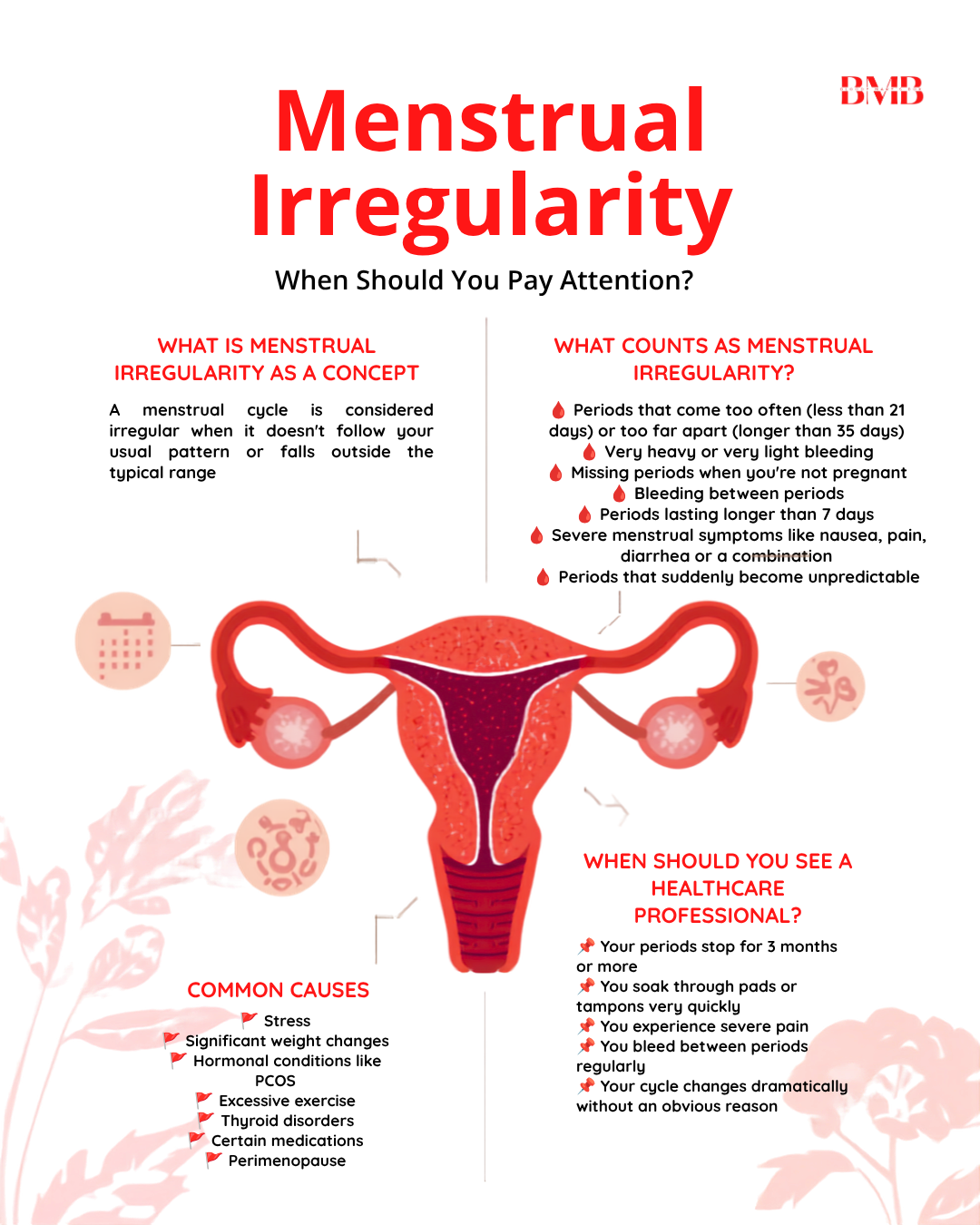
A “regular” cycle runs somewhere between 21 and 35 days. Your period should last 2 to 7 days, and the amount you bleed should be roughly consistent cycle to cycle.
Menstrual irregularity is basically anything that throws that off. Periods that are too early, too late, too heavy, too light, too long, too short, or just missing entirely. It’s more common than people talk about, and it doesn’t automatically mean something is terribly wrong but it does mean your body is trying to tell you something.
Think of it like a WhatsApp notification you keep ignoring. You can leave it on read for a while, but eventually you need to open the message.
The Types of Irregular Period Energy (Yes, We’re Giving Them Names)
The Ghost Period: Your period was due. You waited. Nothing came. You took a pregnancy test just in case (we’ve all been there). Negative. And yet, still nothing. This is called amenorrhea, and it can happen because of stress, significant weight changes, over-exercising, or hormonal conditions like PCOS.
The Drama Queen Period: It arrives. It ARRIVES. Flooding, clotting, changing your pad or tampon every hour, soaking through at night. Heavy menstrual bleeding (menorrhagia) is not something you should just push through every month. That level of blood loss adds up and can cause anaemia which explains why you’re always tired, by the way.
The Commitment-Phobe Period: Shows up for a day or two and disappears. You’re left wondering if it even counted. Light or short periods can be linked to low oestrogen, thyroid issues, or being on certain contraceptives.
The Erratic One: No pattern whatsoever. Sometimes 24 days, sometimes 45. Early one month, missing the next. This unpredictability is its own kind of stress, especially when you’re trying to plan your life around it.
The Overstayer: Still here. Day 8. Day 9. Day 10. Babe, it’s been long enough. Cut the show. Periods lasting longer than 7 days consistently warrant attention.
Why Is This Happening? (The Real Ones)
Let’s get into it, because “stress” is not the only answer even if and I’ll hold your hand, your aunty swears it is.
PCOS (Polycystic Ovary Syndrome) – One of the most common culprits. PCOS messes with your hormones in a way that affects ovulation and since your period is tied to whether or not you ovulate, irregular cycles often follow. Other signs include acne that won’t quit, excess hair growth, difficulty losing weight and so much more. If this sounds familiar, please see a doctor. PCOS is manageable.
Thyroid Issues – Your thyroid is a small gland in your neck that has a disproportionate amount of influence over your entire body including your cycle. Both an underactive thyroid (hypothyroidism) and an overactive one (hyperthyroidism) can throw your period completely off.
Stress – Okay, your aunty wasn’t entirely wrong. Chronic stress raises cortisol levels, and high cortisol suppresses the hormones that regulate your cycle. The thing is, the stress doesn’t have to be dramatic, it can be the everyday kind. School. Work deadlines. NEPA. Rent. Whether you’re the next kidnap victim. Nigerian life in general.
Significant Weight Changes – Losing or gaining a lot of weight in a short time affects oestrogen levels. Too little body fat and your body doesn’t produce enough oestrogen to sustain a cycle. Too much, and excess fat tissue can produce oestrogen in ways that disrupt your hormonal balance.
Perimenopause – If you’re in your late 30s or 40s, irregular periods can be a sign that your body is beginning its transition toward menopause. This is normal. Your hormones are shifting, and your cycle will reflect that.
Certain Medications and Contraceptives – Some contraceptives deliberately change or stop your cycle (hormonal IUDs, injections, implants). Some medications like antipsychotics, blood pressure drugs, and others can also affect your cycle as a side effect.
Endometriosis – Tissue similar to your uterine lining growing outside the uterus. It can cause extremely painful, heavy, and irregular periods. Endometriosis is notoriously underdiagnosed in African women largely because we’ve been taught to normalize severe period pain. We are not doing that anymore.
When Should You Actually See a Doctor?
We know, we know. It’s hard to prioritize yourself when there are a hundred other things demanding your attention. But please, see someone if:
- Your period has been missing for 3 months or more and you’re not pregnant
- You’re soaking through a pad or tampon every hour for several hours in a row
- Your period regularly lasts longer than 7 days
- The pain is so severe it stops you from functioning
- You’re spotting between periods consistently
- You’re trying to conceive and your cycles are unpredictable
- Something just feels off and it’s been that way for a while
You know your body, it’s YOURS. Don’t let anyone, including a doctor who brushes you off make you feel like you’re overreacting.
Things That Actually Help (And Things That Don’t)
Things that can genuinely help:
- Tracking your cycle (an app, a journal/notepad – whatever works for you). Data helps doctors help you.
- Reducing processed sugar and alcohol, which can worsen hormonal fluctuations.
- Consistent sleep. Your hormones run on a biological clock and poor sleep disrupts it
- Managing stress, whatever that looks like for you; movement, rest, saying no, therapy.
- Consume Iron-rich foods if you bleed heavily (beans, dark leafy greens, red meat, fortified foods) to help replenish lost nutrients.
Things that are not the answer:
- Drinking every herbal concoction someone posts on Instagram
- Assuming it will “sort itself out” for years on end
- Suffering through severe symptoms because someone told you period pain is just part of being a woman
A Note on Tracking Your Flow
This is where a menstrual cup genuinely changes the game. Because a cup collects your blood rather than absorbing it, you can actually see how much you’re losing each cycle. Most cups have measurement markings. You can finally answer the question “is my flow actually heavy or have I just normalized it?” with real data.
Average blood loss per cycle: 30–80ml. More than 80ml consistently is clinically heavy and worth discussing with your doctor.
Knowledge is everything.
The Bottom Line
Your period is not just an inconvenience that arrives every month to ruin your plans. It is a vital sign. It tells you things about your hormones, your stress levels, your nutrition, your overall health. When it behaves irregularly, your body is communicating and you deserve the information and support to understand what it’s saying.
You are not dramatic for noticing. You are not weak for struggling. And you are absolutely not obligated to just “manage” your way through something that can be addressed.
Go see a gynaecologist. Track your cycle. And in the meantime, we’ve got period care products to support you through every kind of month your body decides to throw at you.